2026 · Author
ScrapeGoat
A web crawler for Go and an MCP server in one binary — point it at a URL and get structured data.
Problem
why this existsGet structured data out of pages whose markup nobody anticipated — without writing selectors or config.
Architecture
napkin sketch, cleaned up- CLIextract · crawl
- Libraryspiders in Go
- MCP serverfor agents
- REST API
One binary with four entry points: a CLI, a Go library, an MCP server for agents like Claude or Cursor, and a REST API for other languages.
Technical decisions
and the trade-offsFind listings by structure
It looks for repeated sibling elements that mostly contain a price and a link, rather than guessing at class names.
Progress to stderr, JSON to stdout
So it pipes cleanly into tools like jq.
Screenshots
taped in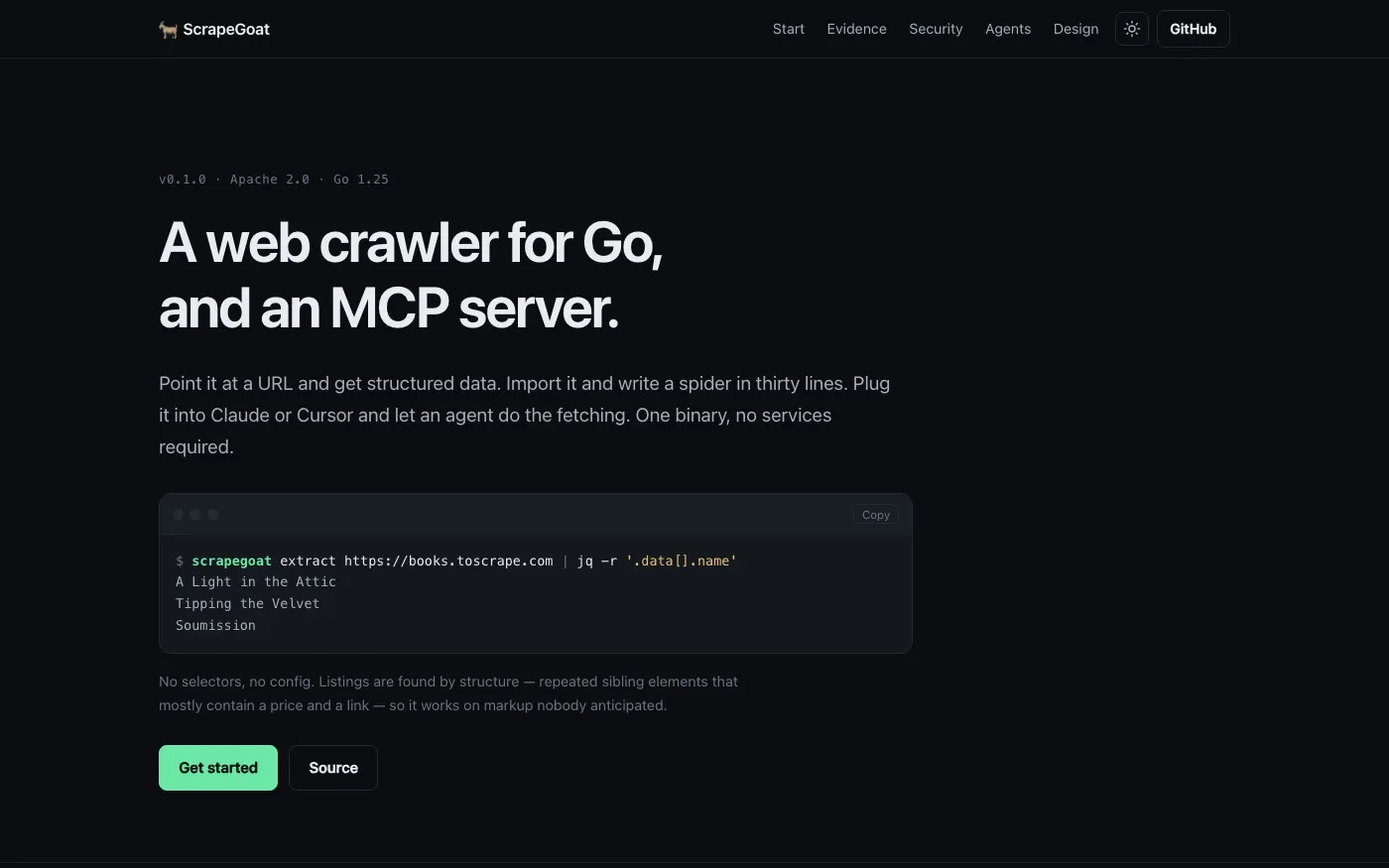 The product site
Key engineering challenges
the bruises- 1
Selector-free extraction
Working on sites whose markup nobody anticipated.
- 2
Fetching URLs someone else chose
Requests to loopback, private, link-local and CGNAT ranges are blocked after DNS; the guard dials the address it validated, so DNS rebinding fails; bodies are capped after decompression.
Results
- ✔ Replaced a 50 ms polling loop in the frontier with an event-driven queue: wake latency 49.1 ms → 3.0 µs
- ✔ 31 published benchmarks, with their method
- ✔ Apache-2.0: 40k lines of Go, 541 tests, 16 merged pull requests
- ✔ Usable from the CLI, Go, an AI agent or a REST client
Learnings
- ✎ A crawler fetches URLs someone else chose — that is the whole threat model.
- ✎ Delete unwired features instead of leaving them looking finished.